


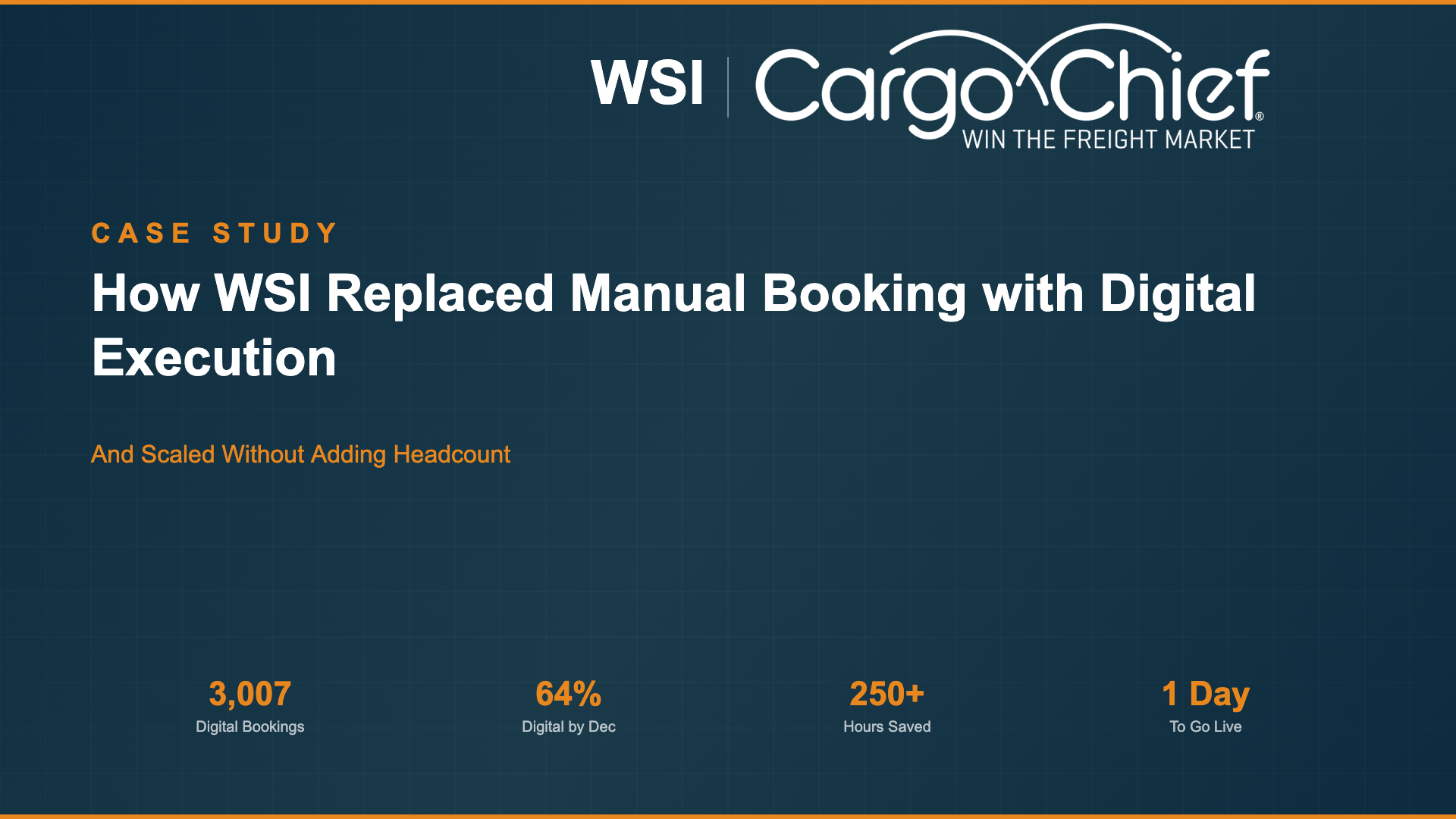
CASE STUDY
How WSI Replaced Manual Booking with Digital Execution
And Scaled Without Adding Headcount
Executive Summary
In one quarter, WSI shifted from a manual, repetitive booking model to a scalable digital execution layer. Starting in October 2025, the brokerage launched a focused pilot and expanded rapidly. By December, nearly two thirds of all loads were booked digitally, with consistent speed and predictable outcomes across more than 3,000 digital bookings.
Carriers engaged faster because the workflow reduced friction and increased visibility. Internally, the team reclaimed weeks of capacity to focus on harder lanes, deeper relationships, and growth without adding headcount. The TMS integration went live in a single day, and the system was fully operational within a week.
The result was not just faster booking. It was a structurally scalable brokerage operation, built on trust, clarity, and execution that keeps up as the business grows.
| 3,007 Digital Bookings in Q4 | 64% Loads Booked Digitally by Dec | 250+ hours Manual Work Absorbed in Q4 | 1 Day TMS Integration to Go Live |
Customer Overview
WSI is a privately held logistics provider with more than 60 years of experience across warehousing, shipping, and freight brokerage. The brokerage operates alongside a small asset fleet (five trucks, ten trailers) and a large warehousing footprint, giving WSI end to end control over how freight moves for its customers. At roughly $10–15 million in top line brokerage revenue, WSI serves a regional customer base with heavy repeat freight across lanes in Wisconsin, Texas, and California.
That structure created a steady flow of repeat freight and long-standing carrier relationships, but it also exposed a growing execution problem.
The Before: When Stability Becomes a Constraint
WSI did not struggle to move freight. Lanes were familiar, carriers were known, and outcomes were predictable. The challenge was how much manual effort it took to execute that predictability.
Booking repeat freight required the same steps every time: entering rates from a spreadsheet, sending tenders, following up, issuing rate confirmations. Even when everyone knew which carrier would take the load, the work still had to be done over and over again, hundreds of times a day.
Dave Stone, Senior Director of Freight Brokerage at WSI, described the reality:
“You end up seeing the same lanes going to the same carriers at the same rate. It almost became an exercise in manual operations. When you’re talking hundreds of loads doing this on a daily basis, it becomes completely inefficient.”
– Dave Stone
As volume increased, the cost was not just time. It was opportunity. Reps were burning full days on work that added no strategic value. The problem was not effort. It was where that effort was going:
“If you’re spending all your time dealing with the carriers that you know what their rate is, you know what their lane is, and it’s just sending them the tender, then you’re not actually spending time on the things that actually matter more.”
– Dave Stone
And the problem extended beyond the brokerage floor: WSI’s internal asset team relied on screenshots and spreadsheets to coordinate loads with the brokerage, creating yet another layer of manual back and forth.
Hiring more people would increase cost, but it would not fix the underlying issue: booking capacity was still tied directly to human effort. WSI needed a way to protect service on repeat lanes while freeing the team to work on what moves the business forward.
The Pivot: Proving ROI Before Changing the Model
WSI had seen enough logistics technology come and go to be cautious. From 2019’s digital freight matching wave through the correction that followed, the industry had learned a hard lesson: technology for the sake of technology does not work. Every conversation came back to a simple question: will this pay for itself?
“How much do I pay for a human to do this? How much is Cargo Chief? Do those pieces match out? And if I were to roll this out today, what could that human be doing versus what they’re doing today? When you look at those numbers side by side, all else equal, it’s a no brainer.”
– Dave Stone
Instead of a broad rollout, WSI started with a focused pilot: one dedicated carrier, repeat lanes, known rates. The goal was to validate three things: carrier adoption, internal adoption, and execution speed without risking service or creating friction. If the math worked on a single carrier, the model would scale.
The Progression: Pilot to Production
September: Launch
WSI activated its first workflow in September 2025, routing repeat lanes for a dedicated carrier through Cargo Chief’s digital booking system. Carrier onboarding was handled directly by the Cargo Chief team, ensuring carriers understood the process and felt supported from the start.
The impact showed up immediately. Loads that once took a rep’s constant attention moved through the system automatically, confirming that digital booking could replace not complicate existing workflows.
“From the moment we rolled it out until that carrier was accepting those loads, it was extremely quick. Carrier had very little feedback on that, which tells me the carrier is excited about it.”
– Dave Stone
October: Scaling the Pilot
With initial validation complete, WSI expanded carrier coverage and added additional workflows through October.
| Metric | October |
| Digital bookings | 990 |
| Median total time to book | ~10.7 minutes |
| Median engagement → booking | ~26 seconds |
| Loads booked in under 15 min | ~58% |
November: Expansion Without Degradation
More freight flowed through automation in November. Speed held steady as usage increased, and booking outcomes became more predictable. This was the first clear signal that the system was not just fast — it was reliable at higher volume.
| Metric | November |
| Digital bookings | 971 |
| Median total time to book | ~12.3 minutes |
| Median engagement → booking | ~19 seconds |
| Loads booked in under 15 min | ~61% |
| Loads booked in under 60 min | ~84% |
December: Digital Becomes Core Infrastructure
By December, digital booking was no longer a pilot — it became a primary execution path.
| Metric | December |
| Total loads | 1,633 |
| Digitally booked | 1,046 |
| Digital booking rate | 64% |
| Median total time to book | ~13.7 minutes |
| Loads booked in under 60 min | ~84% |
| Best weekly digital booking rate | 80%+ |
“The biggest piece for us on stats is the percentage of loads that are digitally booked. When you see over 50% and in December, 64% — that’s a huge piece for us.”
– Dave Stone
Why It Worked: Carrier Experience as the Flywheel
The gains WSI saw were not driven by internal efficiency alone. They were driven by a fundamental change in how carriers experienced the relationship.
Instead of emailed tenders, PDFs, and follow ups, carriers gained immediate visibility into loads as soon as WSI saw them. Rates were clear. Actions were simple. Decisions could be made without waiting on a phone call or an email reply. Carriers knew when they were prioritized on a lane because they saw those loads first — and they could plan capacity faster, fill trucks sooner, and rely on consistent execution.
“The moment that we get a load via EDI and flip it over so carriers can see it, you’re seeing carriers respond very quickly. I’m seeing loads accepted in less than five minutes. That’s the crown jewel of the carrier relationship.”
– Dave Stone
The trust this created showed up in an unexpected way. A dedicated carrier that had only been handling certain specific lanes spotted a new customer’s freight appear in Cargo Chief — freight that matched their capacity. Without WSI reaching out, the carrier called and said, “Hey, I see you guys have this new lane. We’d love to touch this lane too.” They were set up as priority on the new lane and started covering it immediately — all because the system gave them visibility they had never had before.
That organic expansion — carriers proactively growing their relationship with WSI — is the flywheel in action. The more visibility carriers have, the more capacity they offer. The more capacity they offer, the less time WSI spends on manual procurement.
Internal Adoption: The Real Proof
Technology rollouts in brokerage have a reputation problem. Leaders buy the “unicorn tech,” roll it out with fanfare, and six months later the floor has quietly stopped using it. Dave was blunt about the pattern:
“As leaders, we do a bad job of rolling out technology because typically what do we do? We get sold the absolute unicorn tech, this is gonna be the greatest thing ever. And we roll this stuff out. And then all of a sudden you talk to the floor and they’re like, dude, we don’t use that. That’s garbage.”
– Dave Stone
Cargo Chief broke that pattern at WSI — not through top-down mandates, but through organic buy in. Carrier sales reps started teaching other reps on the floor what the system could do. They discovered features on their own and shared them with leadership. Meanwhile, carriers themselves were reaching out to confirm they were using the system correctly — not because they had to, but because they wanted to make sure they did not miss loads.
“I actually have carrier sales reps that are telling me things about Cargo Chief that I didn’t even know. They’re rolling things out to me going, ‘Hey, did you know it can actually do this?’ That’s the aha moment — does this technology work? Well, if you have two sets telling you they like it, then it’s just a matter of how you execute on a broader scale.”
– Dave Stone
When the floor is selling the technology to leadership instead of the other way around, adoption is no longer a risk — it is a signal that the tool is solving the right problem.
Implementation: Live in a Day
Speed of implementation was a deciding factor for WSI. With TMS integrations in the logistics space typically taking months of planning and coordination, the Cargo Chief–TIE integration stood out.
“From the time we said, ‘let’s go,’ that same day, we were up and running on our first workflow with that dedicated carrier. Within the first week, we were 100% live all the way through. TIE and Cargo Chief was a simple integration, and it literally took a day.”
– Dave Stone
The integration delivered real time load flow: the moment WSI flipped a load into a new status inside TIE, it was immediately visible to carriers in Cargo Chief. Carrier acceptance was reflected back into the TMS instantly, eliminating the ambiguity of “is this load actually covered?”
Beyond the initial setup, WSI called out the responsiveness of the Cargo Chief team when issues arose:
“You don’t feel like a number in a ticketing system. You feel like they actually want to move at the same speed and urgency that you have. Even if that means Cargo Chief is manually pushing something over while they go off and investigate.”
– Dave Stone
Asset Side Automation
The impact extended beyond third party carriers. Before Cargo Chief, coordinating loads with WSI’s internal asset fleet was an exercise in manual workarounds: screenshots of TMS load boards sent over to the asset team, spreadsheets traded back and forth to confirm rates, and constant risk of data entry errors.
“We would take a screenshot of loads sitting inside of our TMS. We’d send it to the assets and say, can you cover this? And they would say, yeah, I can do this one. No, I can’t do this one. But you need to send me XYZ. Then we’d have a spreadsheet and go through and say, what rate was that lane? I typed it in wrong. Oh my gosh, like what’s going on?”
– Dave Stone
Now, WSI’s internal fleet is set up with priority workflows in Cargo Chief. Any load that appears in their region is automatically routed to the asset team first. Rates are prebuilt, no spreadsheet, no human in the middle. The assets get first right of refusal, and if they pass, the load flows automatically to the next carrier in the waterfall. No manual reposting required.
Operational Impact: Capacity Without Headcount
Before Cargo Chief, Dave described a team that was spent by the end of every day just sending tenders. With a conservative estimate of five minutes of manual effort per load (entering rates, sending tenders, confirming with the carrier, issuing the rate con), the capacity reclaimed in Q4 alone was substantial:
| Q4 Aggregate (Oct–Dec) | Result |
| Total digital bookings | 3,007 |
| Manual effort absorbed (at 5 min/load) | ~250 hours |
| Full time capacity equivalent | ~6+ weeks |
| Digital booking rate | 64% avg, 80%+ at best |
| Time from launch to fully live | 1 week |
Critically, this work happened in parallel. Loads progressed simultaneously instead of competing for a rep’s attention, removing booking as a bottleneck as volume grew. The team shifted from executing known freight to focusing on hard to cover lanes, new carrier sourcing, and relationship building — the work that drives brokerage growth.
What’s Next
WSI is continuing to expand its use of Cargo Chief across additional carriers, lanes, and workflows. With the manual booking baseline largely automated, the focus is shifting to using the freed capacity to grow the brokerage — targeting new customers, tougher lanes, and deeper carrier relationships.
“The more that we can get into the digital space means we spend more time actually doing legit procurement of hard lanes where we can go find those carriers to onboard. That is where you’re really gonna build this brokerage out.”
– Dave Stone